Psychotherapy, as most of us know it, was born in the Western world. Its theories, diagnostic systems, and treatment models were developed within a specific cultural framework — one shaped by Western medicine, individualism, and scientific empiricism.
This foundation has generated powerful tools. Evidence-based therapies reduce suffering. Diagnostic clarity can guide treatment. Medication and psychotherapy have transformed countless lives.
And yet, this model was not designed with every community in mind.
Research consistently shows that racial and ethnic minorities in the United States are less likely to engage in therapy, more likely to drop out prematurely, and less likely to experience positive outcomes compared to their white counterparts.
When this pattern repeats across communities, it prompts an essential question:
Is the issue the individual — or the model of care itself?
What Do We Mean by Healing in Therapy?
The Oxford definition of healing is “the process of making or becoming sound or healthy again.” In clinical settings, healing is often equated with symptom reduction — fewer panic attacks, improved sleep, or lower depression scores.
These are meaningful outcomes. But across cultures, healing is not always synonymous with symptom elimination.
Healing may also mean:
- Restoring dignity after discrimination
- Rebuilding identity after migration
- Reconnecting to community after isolation
- Learning to hold pain without erasing it
In therapy rooms, clinicians often rely on diagnostic frameworks such as the DSM-5. Diagnosis can be clarifying and therapeutic. Psychoeducation can reduce shame and provide language for suffering.
Yet distress does not always fit neatly into diagnostic categories.
Cultural context shapes how suffering is experienced, expressed, and understood.
If healing is the goal, context cannot be optional.
Why Psychotherapy Must Be Culturally Responsive
Western psychotherapy often emphasizes:
- Emotional expression as inherently healthy
- Individual autonomy as central
- Insight as the primary path to change
But these assumptions are not universal.
In some cultures:
- Emotional restraint is adaptive
- Family reputation carries more weight than individual expression
- Healing happens in community, not in private
When therapy applies a one-size-fits-all approach, cultural mismatch can occur.
This mismatch may appear as:
- Resistance
- Disengagement
- “Noncompliance”
But often, it reflects a deeper misalignment between cultural values and therapeutic expectations.
How Culture Shapes Mental Health and Distress
Mental health conditions exist across cultures, but how symptoms appear and are communicated varies significantly.
For example:
- Some Asian clients may express distress through physical symptoms (fatigue, dizziness)
- Some Latinx clients may describe depression as “nervios”
- Cultural beliefs may frame distress as biological, spiritual, moral, or relational
Culture also shapes mental health stigma.
In many communities, mental illness is not just individual — it reflects on the family or community. This can significantly impact whether someone seeks therapy at all.
For many racial and ethnic minorities, mistrust of healthcare systems is not abstract — it is historical and lived.
Experiences of:
- Racism
- Misdiagnosis
- Institutional bias
can shape whether therapy feels safe.
Healing requires safety.
Safety requires acknowledgment.
Beyond the Individual: Community and Collective Healing
Culturally responsive therapy expands beyond individual treatment.
For many communities, healing happens through:
- Cultural identity and pride
- Spiritual or religious practices
- Family and community connection
- Collective support systems
- Traditional healing practices
Research shows that culturally adapted therapy improves engagement and retention.
When clients are active participants — not passive recipients — healing becomes more sustainable.
The 4 C’s of Culturally Sensitive Therapy
Culturally responsive psychotherapy can be grounded in four key principles:
1. Curiosity
A genuine, non-assumptive interest in a client’s cultural experience.
2. Comfort
Creating a space where identity, language, and lived experience are respected.
3. Clarity
Ensuring shared understanding of diagnosis, goals, and expectations.
4. Confidence
Demonstrating competence while remaining open to learning.
Cultural competence is not mastery — it is an ongoing practice of humility and responsiveness.
The Culture of the Therapist Matters Too
Clinicians also operate within cultural frameworks.
Western therapy often prioritizes:
- Objectivity
- Verbal processing
- Scientific explanation
These approaches are valuable — but not culturally neutral.
Differences between therapist and client can shape assumptions about:
- The cause of distress
- Appropriate treatment
- The role of medication
- What “progress” looks like
Research has also shown disparities such as:
- Overdiagnosis of schizophrenia in Black patients
- Underdiagnosis of mood disorders
Acknowledging this is not blame — it is awareness of systemic influence.
Immigration, Trauma, and Social Context in Mental Health
Migration itself is a psychological stressor.
Acculturative stress often follows a pattern of:
- Initial optimism
- Disillusionment
- Gradual adaptation
Refugees and immigrants may carry trauma related to:
- War
- Displacement
- Political instability
These experiences are not individual pathology — they are responses to structural and systemic stress.
Social determinants such as:
- Poverty
- Discrimination
- Chronic stress
also significantly impact mental health.
Healing that ignores context risks pathologizing survival.
Rethinking Healing: A More Expansive Approach
So what does healing really mean?
- Is it symptom reduction?
- Emotional expression?
- Restoring community connection?
- Building resilience in the face of injustice?
For some, healing means speaking.
For others, it means being understood without explaining.
For others, it means reclaiming identity.
Therapy is not one-size-fits-all — it never was.
Culturally responsive psychotherapy does not discard science. It contextualizes it.
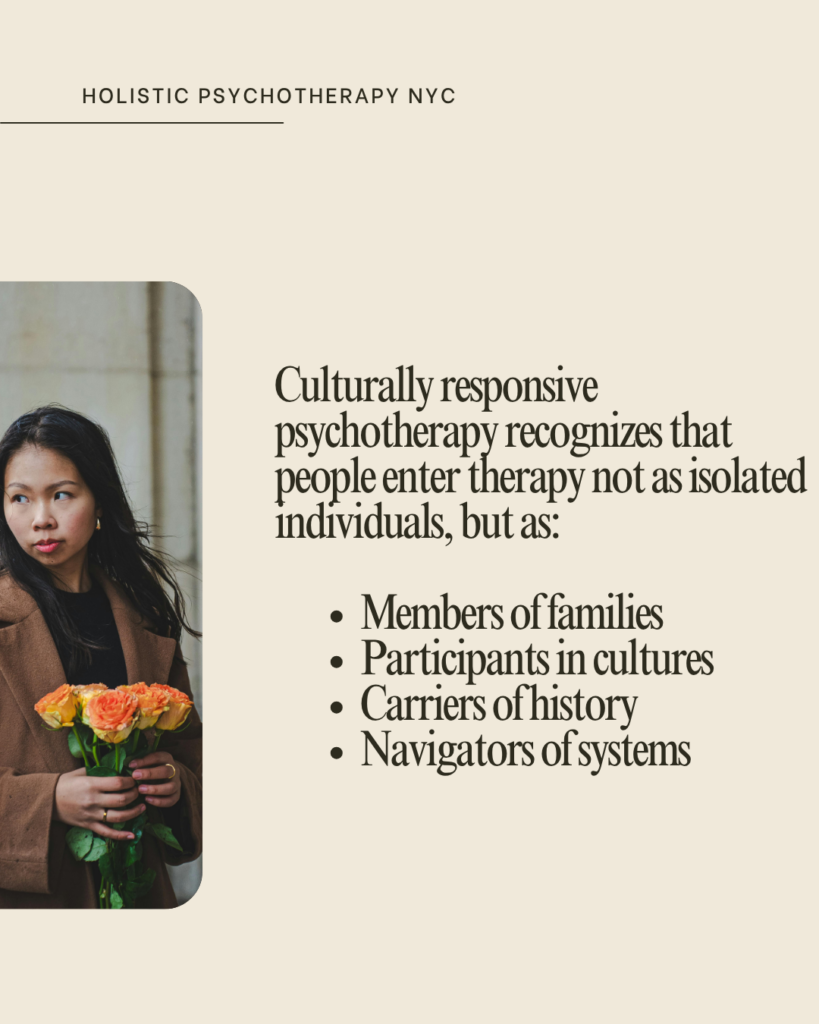
It recognizes that people enter therapy not as isolated individuals, but as:
- Members of families
- Participants in cultures
- Carriers of history
- Navigators of systems
Healing must be spacious enough to hold all of that.
Only then can it truly be called healing.