Some people accomplish a great deal in their lives. They work hard, meet responsibilities, achieve milestones, and are often viewed by others as capable and successful. Yet internally, something feels missing.
Achievements are completed, but pride rarely follows. Compliments feel uncomfortable. Recognition is deflected or minimized. Even meaningful progress quickly fades into the background as the mind moves to the next task or the next standard that must be met.
From the outside, this can appear like humility or discipline. Internally, however, it often feels like a quiet inability to absorb a sense of “enough.”
This experience is more common than many people realize, particularly among individuals who learned early in life that achievement mattered more than emotional acknowledgment.
When Accomplishment Doesn’t Translate Into Self-Worth
Many people who struggle to feel proud of themselves did not grow up in environments where emotional recognition was consistently offered.
There may not have been overt criticism — sometimes there was simply an absence of affirmation.
A child might bring home strong grades and hear the undertone of:
“That’s what you’re supposed to do.”
Effort and responsibility were expected rather than celebrated.
In some families, praise was viewed as unnecessary. In others, it was withheld out of concern that recognition might lead to complacency. Love was expressed through care — food, shelter, education — but emotional validation was limited or absent.
Children naturally look to caregivers to reflect their efforts back to them. When that reflection is missing, they internalize the silence.
The unspoken conclusion often becomes:
If what I do were truly meaningful, someone would say so.
Over time, this shapes how achievement and self-worth become linked.
The Development of the Internal Scorekeeper
Human beings require a sense of value and competence. When that validation is not reliably provided externally, the mind adapts by creating its own system of evaluation.
An internal rulebook develops:
- If others do not notice effort, evaluate it yourself
- If recognition does not come, raise the standard
- If approval is uncertain, achievement must prove worth
This creates what can be understood as an internal scorekeeper — a voice that constantly evaluates performance and recalculates what counts as “good enough.”
This system can be highly effective. Many individuals become:
- Self-directed
- Disciplined
- Reliable
- High-achieving
But the same system that drives success can also block satisfaction.
The scorekeeper rarely stops evaluating.
Why Compliments Feel Uncomfortable
For those shaped by internal evaluation, external praise can feel unfamiliar or even unsettling.
When someone says, “You did an amazing job,” the response is often not relief, but analysis.
The mind may quickly respond:
- Maybe they’re just being polite
- Maybe they don’t see the flaws
- Maybe it was luck
This leads to common patterns:
- Deflection: “It wasn’t a big deal.”
- Discounting: Minimizing parts of the praise
- Suspicion: Questioning the sincerity
This does not mean a lack of competence. Many individuals know they are capable.
The difficulty lies in translating recognition into a felt sense of worth.
The Achievement Trap: When Self-Worth Depends on Performance
In many environments, success becomes the primary measure of value.
Academic achievement, productivity, and recognition become markers of worth.
This can lead to conditional self-worth, where:
- Success temporarily increases self-esteem
- Mistakes sharply reduce it
Common signs include:
- Perfectionism and chronic dissatisfaction
- Difficulty enjoying accomplishments
- Constant comparison with others
- Imposter syndrome despite success
- Fear of mistakes or criticism
When worth is tied to achievement alone, pride becomes fragile and short-lived.
👉 This pattern often overlaps with experiences of imposter syndrome and learned self-doubt
👉 It can also connect to chronic stress and burnout in high-achieving individuals
Cultural Pressures Around Achievement and Identity
Cultural context plays a significant role in shaping how self-worth is experienced.
In many collectivist cultures:
- Success reflects family reputation
- Achievement is tied to responsibility
- Failure impacts more than the individual
Children may internalize messages such as:
- Success maintains family respect
- Failure reflects on loved ones
- Achievement is expected, not optional
In these contexts, pride can feel complicated. Acknowledging success may feel uncomfortable, especially when humility is emphasized.
The Paradox of High Achievers
Many people who struggle to feel proud of themselves appear highly capable.
They often demonstrate:
- Strong work ethic
- Reliability
- High standards
- Independence
These strengths are real — but they often come with hidden costs:
- Difficulty asking for help
- Chronic dissatisfaction
- Emotional disconnection from success
- Burnout despite achievement
👉 This can also show up as hyper-independence or difficulty receiving support
In many cases, the issue is not lack of success.
It is the absence of internal permission to acknowledge it.
Learning to Let Recognition In
Changing patterns of self-evaluation takes time.
Some small shifts can begin the process:
- Pause before deflecting praise
- Accept acknowledgment without analysis (“Thank you” is enough)
- Notice effort, not just outcomes
- Recognize internal growth, not just external results
These practices help reconnect achievement with internal recognition.
Building a More Stable Sense of Self-Worth
Long-term change involves shifting self-worth away from performance alone.
This includes:
- Identifying personal values beyond achievement
- Practicing self-compassion instead of self-criticism
- Expanding the definition of success
- Allowing pride in small, quiet moments
Growth is not only professional — it is emotional, relational, and internal.
Rewriting the Relationship Between Achievement and Worth
At its core, difficulty feeling proud is not about achievement itself. It is about early experiences that shaped how recognition and worth were understood.
Children who grow up without consistent affirmation often become:
- Independent
- Resilient
- Capable
But they may also struggle to:
- Absorb appreciation
- Rest in accomplishment
- Feel satisfied with progress
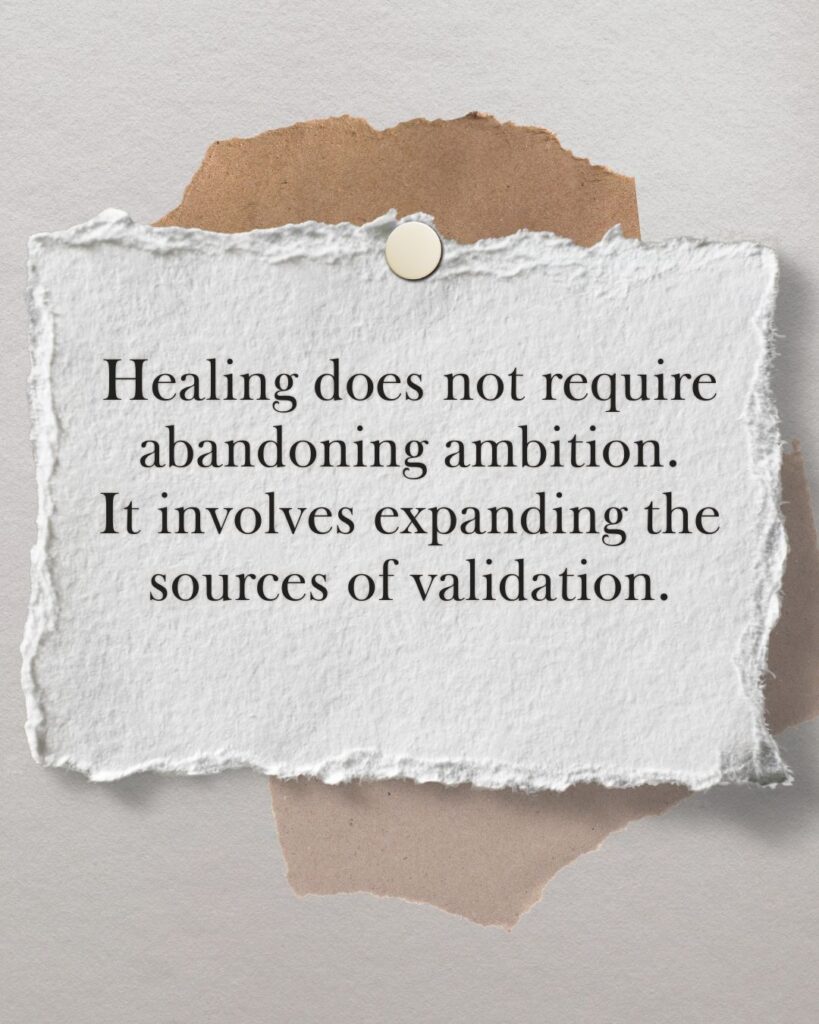
Healing does not require abandoning ambition.
It involves expanding the sources of validation.
Sometimes it begins with something small:
Pausing after completing a task.
Noticing the effort involved.
Allowing a moment of recognition.
Not because perfection was achieved —
but because effort, growth, and persistence deserve to be seen.