Finding the right therapist can feel surprisingly personal. You may be looking for someone who understands anxiety, grief, identity, or relationships, but you may also be looking for something harder to put into a search bar: a therapist with whom you can actually feel like yourself.
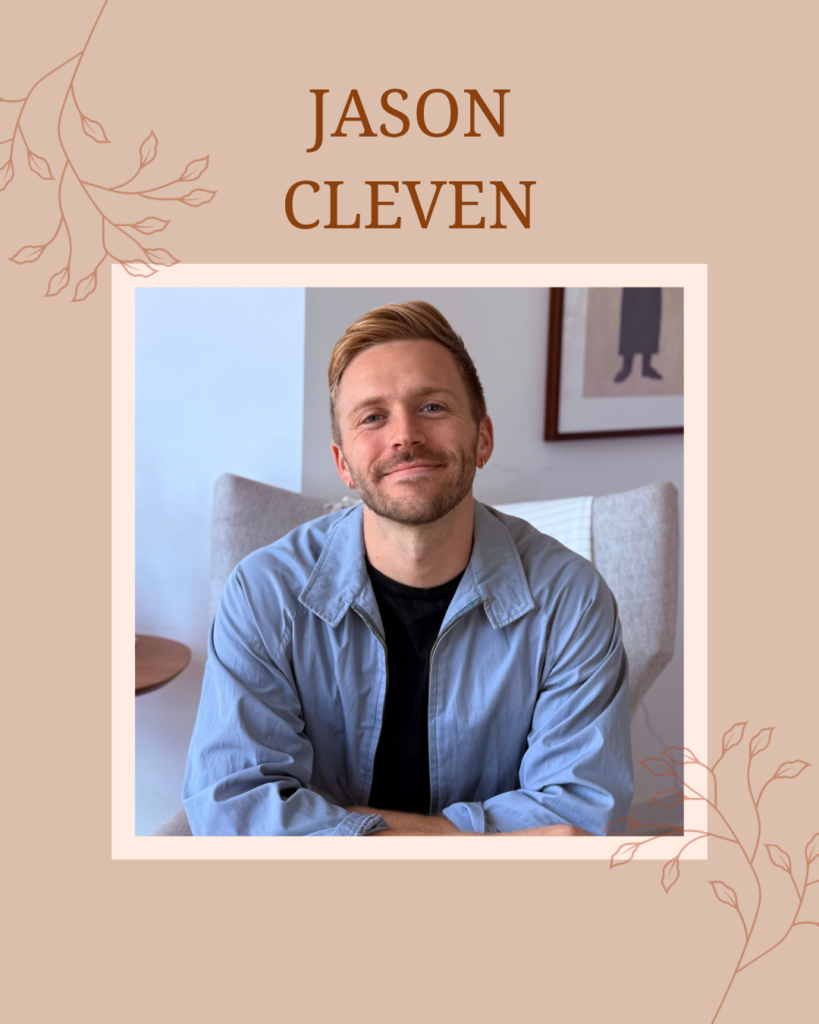
At Holistic Psychotherapy NYC, we are excited to introduce Jason Cleven, MHC-LP, a relational, humanistic therapist who works with adults navigating anxiety, grief, identity exploration, life transitions, relationships, religious trauma, faith transitions, and questions of meaning and belonging. Jason has a particular passion for working with LGBTQIA+ individuals, creatives and artists, and people exploring spirituality or healing from difficult religious experiences. At the center of his work is a simple but powerful belief: meaningful healing often happens in relationship.
When You Are Becoming Someone New
People often come to therapy during periods when something that once felt certain no longer does. Maybe a relationship has changed, a loss has altered the way you understand your life, or the career you worked toward no longer feels like it fits. You may be beginning to question beliefs you inherited about yourself, your relationships, your sexuality, your gender, your faith, or the kind of life you are supposed to build.
Sometimes the change is obvious. Other times, it is more subtle. You may simply have the sense that the version of yourself you have been living as no longer fully fits. Jason is particularly interested in these in-between spaces. Rather than rushing to resolve uncertainty, therapy can offer somewhere to stay curious about it. Who are you becoming? What parts of yourself have not had enough room? Which beliefs still feel like yours, and which ones were handed to you? What becomes possible when you are no longer organizing your life around who you thought you needed to be?
A Relational Approach to Therapy
Jason’s approach is deeply relational. This means therapy is not simply about analyzing your experiences from a distance. It is also about creating a relationship in which you can experience being known, understood, challenged, accepted, and supported.
Many of us learned early in life which parts of ourselves felt welcome in relationships and which parts were safer to hide. Maybe you learned to be agreeable rather than honest, independent rather than needy, successful rather than uncertain, or funny instead of vulnerable. Perhaps you became skilled at adapting yourself to different environments without ever feeling completely known within them. Over time, these strategies can become so familiar that they stop feeling like strategies at all.
Therapy can provide a different kind of relational experience. Jason works collaboratively with clients, paying attention not just to what you are talking about, but also to what it feels like to explore those experiences together. The goal is not to become a different person. It is to develop enough safety and curiosity to become more fully yourself.
LGBTQIA+ Affirming Therapy in NYC
For LGBTQIA+ clients, therapy should not require explaining or defending your identity. Jason has extensive experience working in queer-affirming therapeutic spaces and is passionate about supporting LGBTQIA+ adults navigating identity, relationships, family, belonging, anxiety, grief, spirituality, and major life transitions.
Sometimes LGBTQIA+ affirming therapy directly involves questions about sexuality or gender. Sometimes it does not. You may be navigating work stress, dating, grief, family conflict, perfectionism, or a quarter-life transition while also wanting a therapist who understands that your identity and the social world around you are part of the larger context of your life.
Affirming therapy allows room for all of this. There is no predetermined version of who you are supposed to become. Instead, therapy can be a space to explore what authenticity, connection, intimacy, community, and belonging mean to you.
Healing From Religious Trauma and Exploring Faith Transitions
Religious communities can provide belonging, meaning, ritual, identity, family, and connection. They can also sometimes become sources of shame, fear, control, rejection, or trauma. Leaving or questioning a religious tradition can therefore be much more emotionally complicated than simply changing your beliefs.
You may be grieving a community, questioning ideas you were once taught were absolute, or reconsidering your sexuality, gender, relationships, morality, or sense of self. You may feel anger toward a religious institution while still longing for spirituality, or you may be unsure whether you want any relationship with faith at all.
Jason works with individuals navigating religious trauma, faith transitions, spirituality, and changing belief systems. This work is not about moving you toward religion or away from it. It is about creating enough space for you to understand what you actually believe, what you want to keep, what you may need to grieve, and what no longer feels like yours. For many people, healing from religious trauma involves learning to trust their own internal experience again.
Therapy for Creatives and Artists in NYC
Creative work asks something uniquely vulnerable of us. Artists, writers, performers, musicians, designers, and other creative professionals are often creating work that is deeply personal while also navigating an industry filled with rejection, comparison, instability, visibility, and pressure.
The line between your work and your identity can become difficult to separate. A rejection may feel bigger than a professional disappointment, creative blocks may become tied to questions about worth, and success can introduce its own anxiety. When your work relies on imagination, emotion, and self-expression, burnout can affect more than productivity. It can create a feeling of disconnection from an important part of yourself.
Jason has a particular interest in working with artists and creatives in New York City. His background in expressive and experiential approaches allows therapy to make room for ways of understanding yourself that are not limited to intellectual analysis. For some clients, the work may involve anxiety, perfectionism, career uncertainty, creative blocks, self-esteem, or burnout. For others, therapy becomes a place to explore the relationship between creativity and identity itself.
Grief Is Not Always About Death
Grief can enter our lives in many forms. There is grief after losing someone we love, but also grief around relationships, communities, identities, careers, beliefs, and futures we once imagined.
You can grieve the family relationship you hoped you would have, the version of yourself you thought you would become, a religious community you can no longer return to, or a relationship that ended even though ending it was the right decision. You can also grieve a chapter of life that you were ready to leave and still miss.
Jason works with clients navigating grief and complex loss, including losses that other people may not immediately recognize as grief. Therapy does not require you to quickly “move on.” Sometimes healing begins by allowing the loss to matter.
When Anxiety Is Trying to Tell You Something
Anxiety can feel like a problem to eliminate, and understandably so. It can look like overthinking, social anxiety, chronic self-doubt, difficulty making decisions, fear of disappointing other people, or constantly imagining everything that could go wrong.
But anxiety can also contain information. It may appear when you are moving toward something unfamiliar, when old beliefs are being challenged, when you fear losing belonging, when a relationship matters deeply, or when the life you want requires stepping outside of an identity that once kept you safe.
Jason helps clients develop tools for working with anxiety while also becoming curious about what sits beneath it. Instead of only asking, “How do I make this feeling stop?” therapy can sometimes ask another question: “What is this feeling trying to protect?”
Therapy That Includes Mind, Body, and Spirit
Jason takes an integrative approach to psychotherapy because people rarely fit neatly into one therapeutic model. His work draws from humanistic therapy, existential therapy, somatic approaches, relational therapy, and an expressive IFS framework.
That means therapy might involve talking through a relationship pattern one week and noticing how an emotion lives in your body the next. It may involve exploring the different “parts” of yourself that seem to want contradictory things, or making room for grief, meaning, identity, creativity, spirituality, and the physical sensations that emerge when something becomes emotionally charged.
There is room for intellect in Jason’s work, but therapy does not have to remain entirely in your head. Our experiences live in our bodies, relationships, histories, communities, beliefs, and imaginations too.
You Do Not Need to Arrive With Everything Figured Out
One of the assumptions people sometimes make about therapy is that they should know exactly what they want to work on before they begin. You do not. You may arrive with a specific concern, you may arrive with ten, or you may simply know that something feels off and that continuing in exactly the same way no longer feels sustainable.
Jason believes that meaningful material often emerges as safety develops. There is no need to force the process. Together, you can begin noticing what continually returns, what feels difficult to name, what has been asking for attention, and what might be ready to change.
About Jason Cleven, MHC-LP
Jason earned his Master’s degree in Clinical Mental Health Counseling from Walden University. During his graduate training, he worked at Experience Onsite in Nashville, Tennessee, where he developed a deeper appreciation for experiential, relational, and community-centered approaches to healing.
He later completed clinical training at a queer-affirming somatic practice in Vermont, where he worked primarily with LGBTQIA+ clients and people navigating anxiety, grief, identity exploration, life transitions, and questions of belonging. Today, his work continues to integrate somatic, expressive, creative, humanistic, and relational approaches.
Jason works with adults navigating LGBTQIA+ identity and exploration, religious trauma, faith transitions and spirituality, anxiety and social anxiety, grief and complex loss, life transitions and quarter-life concerns, relationship issues, identity exploration, gender and sexuality, family dynamics, depression, self-esteem, emotion regulation, career and work concerns, trauma, and creative identity.
Looking for an LGBTQIA+ Affirming or Relational Therapist in NYC?
If Jason’s approach resonates with you, you can schedule a free 15-minute consultation with Jason Cleven, MHC-LP to learn more about working together. Jason offers in-person therapy at Holistic Psychotherapy NYC’s Midtown Manhattan office near Grand Central, as well as virtual therapy throughout New York State. He currently offers weekday and evening availability.
Holistic Psychotherapy NYC is in-network with Aetna and Cigna, and we offer a generous sliding scale for clients paying out of pocket. We can also provide superbills and support clients seeking reimbursement through out-of-network insurance benefits.
If you are not sure whether Jason is the right therapist for you, you can also schedule a free therapist matching call with our Intake Coordinator. We will learn more about what you are looking for and help connect you with a therapist whose personality, approach, specialties, and availability may be a good fit.
You do not need to know exactly where therapy will take you before you begin. Sometimes you only need enough curiosity to start the conversation.
Schedule a free consultation with Jason to see if working together feels like a good fit.