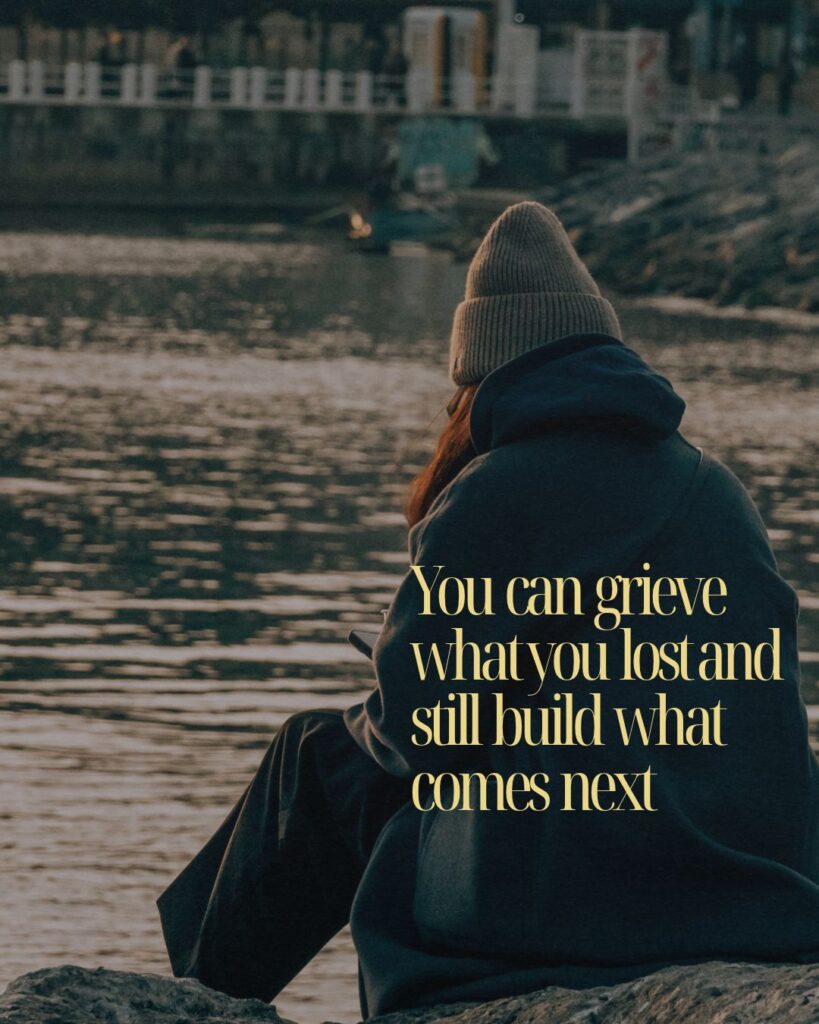
With cuffing season upon us, I’m writing to the people on the other side of it: those grieving a relationship, trying to end one, or getting broken up with.
A breakup is more than losing a person. You’re also losing the future you pictured, the daily life you built around them, and often your main attachment figure, the one you called with good news and bad. That’s a lot to lose at once, and many clients are hard on themselves for how much they’re hurting. They feel embarrassed about the crying, the ruminating, the 2 a.m. replays of conversations that are long over.
It can be hard to hear, but a lot of what you’re feeling isn’t about this one person. It’s about what they stood for and what your life looks like without it. So let’s take it step by step. Fair warning: it won’t be a straight line.
Healing Isn’t Linear
Most of us picture grief as a staircase: denial, anger, bargaining, depression, acceptance. It doesn’t really work like that. People who study grief describe it as a back and forth between facing the loss (crying, missing them, replaying everything) and getting on with life (work, friends, trying a new restaurant). Both are part of healing. So if you felt fine on Tuesday and wrecked on Thursday, nothing has gone wrong. That swing is the process.
The Break Up Conversation
If you haven’t broken up yet, it’s best done in person or over the phone. Use your judgment based on the kind of relationship, but ghosting or breaking up over text is worth avoiding. It’s about respect, for the person and for what you had together. If that is not reason enough, consider the relational skills you build by learning to handle difficult conversations or letting someone down (people pleasers, I’m looking at you).
Many breakups lack clarity, and you don’t need to know exactly why someone ended things to make your own sense of it later. A few questions are worth settling, whether you ask your ex or just work them out for yourself:
- Logistics: Did you leave things at their apartment? Are there future plans, money, a lease, a car, or a pet to figure out?
- Communication expectations: What will contact look like from here? Are you taking a break from talking, and for how long?
Space and No Contact
Once the conversation is over, the grief shows up. The longing. The second-guessing about whether this was the right call, or why they didn’t want to stay. The best thing you can do is be gentle with yourself and give yourself room.
You’ll probably feel like reaching out to your ex is the only thing that will make you feel better. It might, for a little while. But there’s a reason it feels that way.
Why this happens: Brain imaging studies of people who were recently rejected in love show activity in reward and craving areas of the brain (Fisher et al., 2010). In a way, you’re in withdrawal. Every text back or quick call brings relief, and it also teaches your brain that this person is how the ache gets solved. Not knowing whether they’ll respond makes the pull even stronger.
Space doesn’t mean you’ll never talk again. It means giving yourself time to settle so you can decide how to relate to them from steadier ground. If you share kids, a workplace, or a friend group, total silence might not be possible. In that case, keep contact short and practical, and leave the big emotional conversations out of it. In the meantime, start building a life that’s centered on you.
Feel the Feelings
Nobody going through a breakup wants to keep feeling the way they do, and accepting the feelings can seem like signing up for a life sentence. So we fight them. It was only a situationship. It only lasted a few months. I shouldn’t be feeling this. That’s arguing with reality, and fighting the experience keeps you stuck in it.
Why this happens: Therapists sometimes call this secondary suffering: the pain first, then the pain about being in pain (I’m pathetic for crying over this). Trying to escape or push away feelings has been linked to a wide range of psychological problems (Hayes et al., 1996). There’s also disenfranchised grief, which is grief other people don’t treat as legitimate, like after a short relationship or a situationship (Doka, 1989). It’s still grief, and it usually hurts more when you feel you have to hide it.
What if you welcomed the feelings instead? “Sadness, you are safe here.” “Longing is natural after the meaningful relationship I had.” Put a hand on your heart, send some breath there, and allow what is. The only way out is through.
Reflection
Once some time has passed and you’re feeling a little better and clearer, you can start asking what this person symbolized for you. What did you like about them? What traits did they have that your life lacks, or that you’re afraid no one else will have? What did being with them change for you? Write the answers down.
From here, you start to get clarity. You’ll probably see things like purpose, certainty, feeling chosen, spontaneity, company, plans. What you’ve written is really a list of what you want. A partner can give you those things, but you don’t have to wait for the next relationship to bring them into your life.
Patience & Self-Compassion
Be patient with the process. Small wins are a sign that things are shifting: a morning you didn’t check their profile (even though you have them muted already: see no contact!), a song you can listen to again, a full night of sleep. Notice them.
Spend time with the people who love you, and make time for yourself too. Do the things your ex used to do for you, like cooking you dinner, planning a weekend, or sending a good morning text. Take yourself on dates.
Opportunity
This might be a chance for real growth and change. Pain can serve a purpose in your life, and you get to decide whether to make it meaningful.
Now that you’re single, is there anything you want to do differently in how you show up in relationships? Did you notice any patterns, like going quiet instead of asking for what you needed, or staying long after you knew it wasn’t working? Are there goals you’ve been putting off? How can you choose yourself even more deeply? You don’t have to answer all of this right now. Let it sit with you.
Building a Future
Life is so uncertain and unpredictable that a relationship can feel like an antidote to not knowing what’s coming. It’s the closest thing we have to a crystal ball, even if it’s just as fragile. With the future you imagined with this person gone, what future, and what present, do you want to build on your own? What stability and certainty can you give yourself?
It can be something small, like a standing Sunday walk, a trip you’ve been putting off, or a class on the calendar. Keeping small promises to yourself builds trust that you can take care of you and grows your confidence.
You don’t have to do this alone. Breakups are one of the most universal human experiences, and also one of the most isolating. Be gentle with yourself on the way through.
References
Doka, K. J. (Ed.). (1989). Disenfranchised grief: Recognizing hidden sorrow. Lexington Books.
Fisher, H. E., Brown, L. L., Aron, A., Strong, G., & Mashek, D. (2010). Reward, addiction, and emotion regulation systems associated with rejection in love. Journal of Neurophysiology, 104(1), 51–60. https://doi.org/10.1152/jn.00784.2009
Hayes, S. C., Wilson, K. G., Gifford, E. V., Follette, V. M., & Strosahl, K. (1996). Experiential avoidance and behavioral disorders: A functional dimensional approach to diagnosis and treatment. Journal of Consulting and Clinical Psychology, 64(6), 1152–1168. https://contextualscience.org/hayes_wilson_gifford_follette_strosahl_1996_0